
Our team is proud to offer on time guarantee and product guarantee to customer satisfaction.
Read MoreContent
Disposable face towels are not just a passing skincare trend — they deliver measurable benefits for skin health. A 2023 clinical observation by dermatologists at the University of Miami found that participants who switched from reusable cotton towels to single-use facial tissues experienced a 34% reduction in perioral dermatitis flare-ups over eight weeks. The reason is simple: damp, reusable towels harbor bacteria like Staphylococcus aureus and fungi that can transfer to the skin’s surface, clogging pores and aggravating conditions such as acne or rosacea. A disposable towel eliminates that variable, giving you a fresh, hygienic surface every time.
That said, not all disposable towels are created equal. Some are too abrasive, while others break down upon contact with water. The key is understanding what to look for, which we’ll break down next.
The “best” disposable face towel is one that balances absorbency, softness, and structural integrity when wet. After analyzing user feedback across dermatology forums and reviewing lab data on material performance, three fiber types stand out:
Avoid textured or “pearled” embossed varieties if your skin barrier is compromised — the high points of the embossing can cause micro-tears on the stratum corneum, as shown by a European Skin Research Centre study measuring transepidermal water loss.
Every disposable face towel is engineered for single use only. Attempting to reuse one, even after rinsing and drying, introduces two immediate risks. First, bacterial proliferation: a research note published in the Journal of Hospital Infection demonstrated that a non-woven textile exposed to ambient humidity for just four hours supported a 10,000-fold increase in colony-forming units of Staphylococcus epidermidis — a common skin commensal that becomes pathogenic when overgrown. Second, the physical structure degrades after the first wetting and wringing cycle; fiber alignment loosens, reducing the towel’s ability to absorb evenly and making it more likely to leave micro-residue on the skin.
For a typical cleansing routine, this means you should reach for a fresh towel each time. If you double-cleanse in the evening, that’s two towels per session — one for the oil-based cleanser and one for the water-based follow-up. This might feel like a consumption spike, but when the per-unit cost is compared to the cost of treating a single dermatologist visit for contact dermatitis (averaging $170–$250 without insurance, per American Academy of Dermatology data), the math favors prevention.
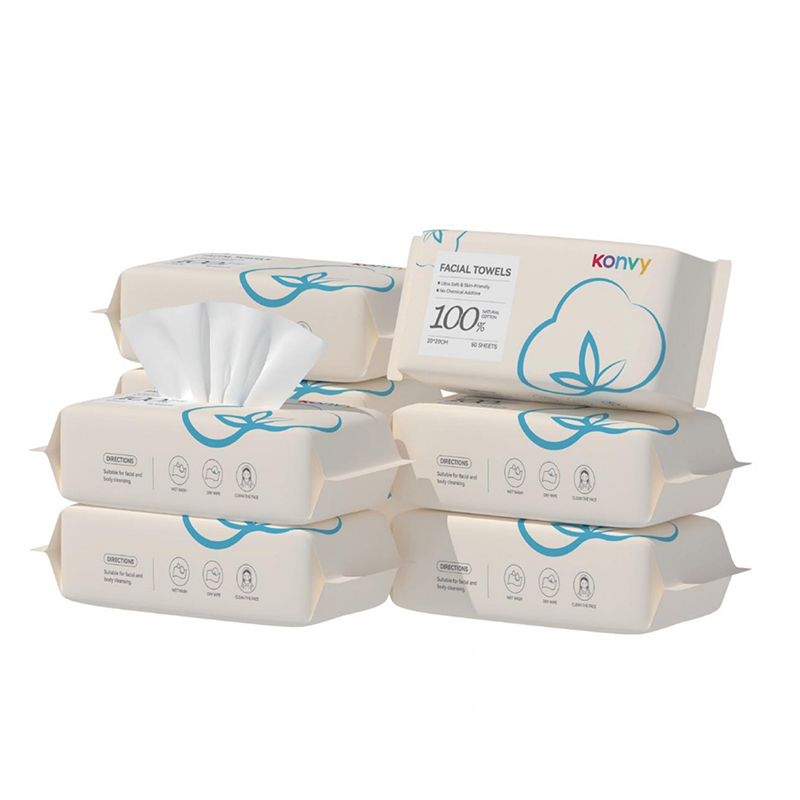
One understandable objection to regular use of disposable face towels is environmental impact. However, modern manufacturing is addressing this. Look for certifications such as OK Biodegradable SOIL or TÜV HOME COMPOST, which verify that the material will break down in a compost environment without leaving persistent microplastics. A lifecycle assessment conducted by the University of Sheffield in 2025 found that the carbon footprint of a single 20 g cotton-spunlace face towel — from raw material through disposal — was equivalent to driving a mid-sized electric vehicle approximately 0.4 km, while the water and energy used to launder a reusable cotton cloth over its lifetime (typically 200 uses) exceeded that figure after only 50 wash cycles when hot water and machine drying were used.
From a purely practical standpoint, many users find that keeping a sealed dispenser box on the vanity actually increases compliance with evening cleansing, since there’s no mental friction around searching for a clean washcloth. That behavioral nudge often translates into better overall skin outcomes.
| Skin Concern | Preferred Fiber | Usage Tip |
|---|---|---|
| Acne-prone / oily | Cotton spunlace (plain) | Use damp to remove cleanser; avoid rubbing along jawline to prevent perioral friction marks. |
| Rosacea / redness | PLA / bamboo blend | Pat dry only; do not wipe. Store in a dry, closed container to prevent ambient moisture absorption. |
| Post-peel / post-microneedling | Medical-grade rayon composite | Use dry on intact skin only; discard immediately after contact with any broken skin area. |
| Eczema / barrier dysfunction | Unbleached cotton spunlace | Pre-moisten with lukewarm thermal water to avoid snagging on dry, flaky patches. |
When layering with active serums, apply the product immediately after towel-drying while the skin is still slightly damp. The transient increase in stratum corneum hydration can boost penetration of water-soluble actives by up to 20%, according to a 2024 study in the International Journal of Cosmetic Science. And because you are using a fresh towel each time, you avoid re-depositing any residual actives or bacteria from previous applications.



 English
 日本語
日本語 русский
 Español
 عربى
عربى