How Wet Wipes Are Made: The Full Manufacturing Process
Wet wipes are manufactured by saturating a nonwoven fabric substrate with a precisely formulated liquid solution, then folding, cutting, packaging, and sealing individual units or stacks into airtight packaging. The process integrates nonwoven fabric production (or procurement), solution formulation, impregnation, converting, and packaging into a continuous or semi-continuous production line. Modern high-speed wet wipe lines produce 300–600 wipes per minute, with output dependent on wipe size, fold type, and packaging format.
The manufacturing sequence for a standard wet wipe product follows these stages:
- Substrate preparation: A roll of nonwoven fabric — spunlace, airlaid, or spunbond — is loaded onto the unwinder of the converting line. The substrate must meet basis weight, tensile strength, absorbency, and softness specifications before impregnation
- Solution preparation: The wetting solution is compounded in a separate mixing tank, typically consisting of purified water (70–95% by weight), humectants, preservatives, surfactants, and functional actives appropriate to the product category
- Impregnation (saturation): The dry substrate passes through an impregnation system — either a dip-and-nip bath, spray system, or transfer roll — where it absorbs the liquid solution to the target lotion-to-substrate ratio, typically 180–350% by weight (i.e., 1.8–3.5 g of solution per gram of dry substrate)
- Folding and cutting: The saturated web is longitudinally folded (cross-fold or Z-fold depending on the dispensing format required) and then cross-cut to individual wipe dimensions, commonly 15×20 cm to 20×30 cm for personal care wipes
- Stacking or interleaving: Individual wipes are stacked in counts of 10, 20, 40, or 80 per pack, or interleaved so each wipe pulls the next through the dispensing opening — the "pop-up" format standard in facial and baby wipe products
- Packaging and sealing: Stacked wipes are loaded into pre-formed plastic pouches, hard-top containers, or flow-wrap film packs and heat-sealed. Canister formats are filled vertically with a continuous rolled log that is then cut to count. Nitrogen flushing or reduced-oxygen atmosphere packaging extends shelf life for preservative-free formulations
- Quality control and labeling: Pack weight verification (confirming correct saturation), seal integrity testing, pH measurement, and microbial testing are conducted in-line or on sampled packs before case packing and palletizing
The lotion-to-substrate (L/S) ratio is the most critical process parameter in wet wipe manufacturing. Too low and the wipe feels dry and has insufficient active delivery; too high and excess liquid pools in packaging, dilutes the active concentration, and creates consumer handling issues. Achieving a consistent L/S ratio across the full production roll width requires precise nip roll pressure control in bath impregnation systems, or accurate spray nozzle calibration in spray impregnation lines.
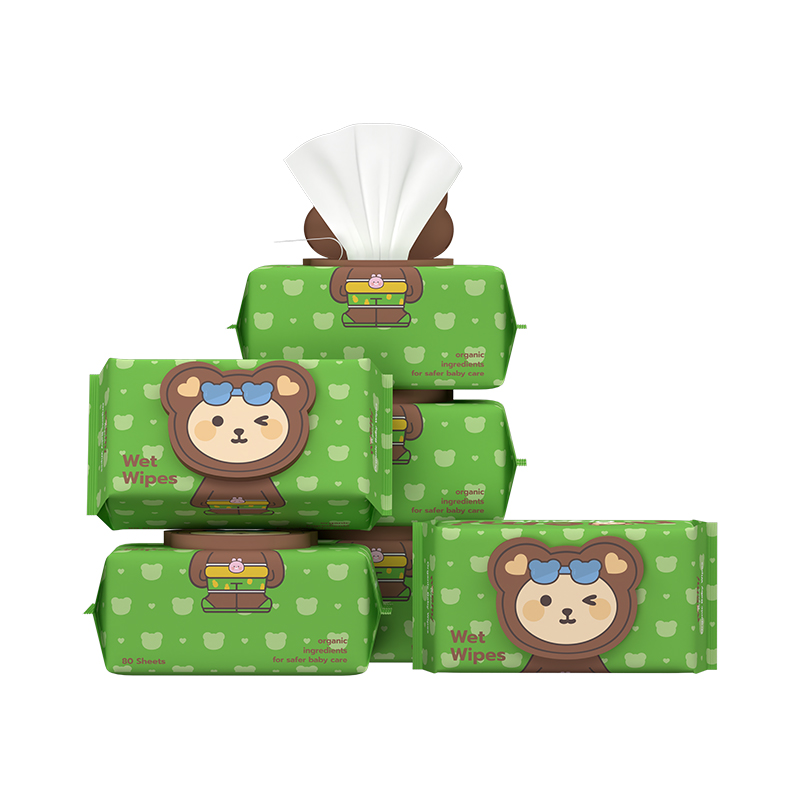
Viscose and Polyester Raw Materials for Wet Wipes
The nonwoven substrate is the structural foundation of any wet wipe — it determines softness, strength, absorbency, linting tendency, and consumer tactile perception. Viscose (rayon) and polyester (PET) fibers are the two most widely used raw materials in wet wipe nonwovens, most commonly combined in blended spunlace fabrics that balance the strengths of each fiber type.
Viscose (Rayon) Fiber in Wet Wipes
Viscose is a regenerated cellulose fiber produced by dissolving wood pulp or cotton linters in sodium hydroxide and carbon disulfide, then extruding through spinnerets into a coagulation bath. For wet wipe applications, viscose fiber is typically cut to 38–51 mm staple length at 1.7–2.2 dtex for spunlace processing. Key performance characteristics of viscose in wipe substrates:
- High absorbency: Viscose absorbs 11–12× its own weight in water — more than twice the absorbency of polyester — making it the primary driver of solution uptake and retention in the finished wipe
- Softness: The round or serrated cross-section of viscose fiber and its natural drape produce a fabric hand that is perceived as soft and cloth-like against skin, a critical consumer acceptance driver in baby and facial wipe categories
- Biodegradability: As a cellulose-based fiber, viscose is inherently biodegradable and compatible with flushability requirements and sustainability claims increasingly demanded in personal care wipes
- Wet strength limitation: Viscose loses approximately 50–60% of its dry tensile strength when wet, which is why it is almost always blended with polyester rather than used alone in wipe substrates that must withstand mechanical use during application
Polyester (PET) Fiber in Wet Wipes
Polyethylene terephthalate (PET) fiber is a synthetic polymer fiber produced by melt spinning. For spunlace wipe substrates, fine-denier PET at 1.2–1.7 dtex and 38–51 mm cut length is most common. Polyester contributes properties that are complementary to — and compensate for the limitations of — viscose:
- Wet strength retention: PET retains virtually 100% of its tensile strength when saturated, providing the structural integrity that allows the wipe to be used with mechanical scrubbing pressure without tearing
- Dimensional stability: Polyester resists elongation and distortion during wetting and drying, maintaining the wipe's shape and preventing shrinkage on the production line during impregnation
- Chemical resistance: PET is inert to most preservative systems, surfactants, and active ingredients used in wipe formulations, making it compatible with a wide range of product chemistries including high-alcohol sanitizing wipes
- Low absorbency: Unlike viscose, PET is hydrophobic — it does not absorb water into the fiber itself but holds solution in the interfiber capillary spaces. This means PET-dominant substrates release their solution more readily onto a surface than viscose-dominant substrates, which is advantageous for cleaning wipes
Viscose/Polyester Blend Ratios and Their Effects
The blend ratio of viscose to polyester is the primary design variable in wipe substrate specification. Common commercial blends and their positioning:
| Blend Ratio (Viscose : PET) |
Key Characteristics |
Typical Application |
| 100% Viscose |
Maximum softness and absorbency; low wet strength; biodegradable |
Flushable wipes, gentle facial wipes |
| 70:30 |
High softness, good absorbency, adequate wet strength for light use |
Baby wipes, feminine care wipes |
| 50:50 |
Balanced softness and strength; versatile across personal care categories |
General personal care wipes, household wipes |
| 30:70 |
Strong, durable, good solution release; less soft than higher viscose grades |
Industrial cleaning wipes, surface disinfection wipes |
| 100% Polyester |
Maximum strength and chemical resistance; low absorbency; not biodegradable |
High-alcohol sanitizing wipes, solvent-based technical wipes |
Viscose/polyester blend ratios in spunlace nonwovens for wet wipes and their application positioning
Spunlace (Hydroentanglement) Processing of Viscose/PET Blends
Virtually all viscose/polyester wipe substrates are produced by the spunlace (hydroentanglement) process, in which high-pressure water jets (50–200 bar) are directed onto a carded and cross-lapped fiber web, mechanically entangling the fibers into a cohesive fabric without chemical binders. Spunlace produces the softest, most textile-like nonwoven fabric available — essential for skin-contact wipe applications — and allows both fiber blend and fabric structure (smooth, apertured, or embossed) to be customized. Typical spunlace wipe substrates range from 40 gsm to 80 gsm, with 50–60 gsm being the most common range for personal care wipes.
Cold Wipes Production: Formulation and Process Considerations
Cold wipes — also called cooling wipes or fever wipes — are wet wipes formulated to deliver a sustained cooling sensation on the skin through evaporative or active cooling mechanisms. They are used for fever reduction in infants and adults, post-exercise recovery, heat stress management in occupational settings, and cosmetic refreshing. Cold wipes production follows the same nonwoven substrate and converting process as standard wet wipes, but the solution formulation and, in some cases, the packaging and storage requirements differ significantly.
Cooling Mechanisms and Key Actives
The cooling effect in cold wipes is achieved through one or more of the following mechanisms:
- Evaporative cooling: High-volatility solvents — primarily isopropanol (IPA) at 20–70% or ethanol — evaporate rapidly from the skin surface, extracting latent heat and producing an immediate cooling sensation. Alcohol-based cooling wipes are the simplest formulation approach; IPA at concentrations above 30% also provides broad-spectrum antimicrobial efficacy, making it suitable for fever management where surface hygiene is concurrent objective
- Menthol and cooling agents: L-menthol at 0.1–2.0% activates the TRPM8 cold-receptor in skin nerve endings, producing a physiological cooling sensation independent of actual temperature change. Synthetic cooling agents such as WS-3 (N-ethyl-p-menthane-3-carboxamide) and Symcool provide longer-lasting cooling perception at lower use levels (0.05–0.5%) than menthol and without menthol's medicinal odor — preferred in cosmetic and sports recovery wipes
- Phase-change materials (PCM): Microencapsulated PCMs incorporated into the wipe substrate or solution absorb heat as they transition from solid to liquid, providing sustained thermal cooling. This technology is used in premium occupational heat stress and military cooling wipes but adds significant cost and formulation complexity
- High water content with low-temperature storage: For clinical cooling (fever reduction), some hospital-grade cold wipes rely simply on high-moisture spunlace fabric stored refrigerated at 4–8 °C, applied directly to the forehead or body. The thermal mass of the cool water in the wipe provides direct conductive cooling without requiring chemical actives
Formulation Challenges in Cold Wipes Production
Cold wipes formulations present specific production and stability challenges that differ from standard personal care wipes:
- Alcohol volatility and packaging integrity: High-IPA formulations (above 40%) require sealed aluminum foil laminate packaging rather than standard polyethylene pouches, as IPA permeates through PE film over time, causing the wipe to dry out on shelf. Seal integrity testing at elevated temperatures is mandatory for alcohol-based cold wipes
- Menthol solubility: L-menthol has limited water solubility (~0.4 g/100 mL at 20 °C) and must be pre-dissolved in a compatible solvent (ethanol, propylene glycol, or a polysorbate solubilizer) before dilution into the aqueous phase. Undissolved menthol crystals in the wipe solution cause uneven active distribution and can block spray nozzles in the impregnation system
- Preservative selection in alcohol systems: At IPA concentrations above 20%, many traditional preservatives (parabens, phenoxyethanol) partition into the alcohol phase and may be less effective in the aqueous phase. Challenge testing across the full product shelf life is essential to confirm adequate broad-spectrum preservation, particularly for wipes intended for use on infants or immunocompromised patients
- Substrate compatibility with high-alcohol solutions: 100% polyester or polyester-dominant (≥70% PET) substrates are required for cold wipes containing IPA above 30% — viscose swells and weakens significantly in contact with high-alcohol solutions, causing fabric degradation, fiber shedding, and inadequate wet tensile strength for use
Cold Wipes Production Line Adaptations
Standard wet wipe production lines require specific adaptations for cold wipes manufacturing with alcohol-based formulations:
- ATEX-rated (explosion-proof) equipment: All electrical components, motors, and control systems in contact with IPA vapor must be certified for use in potentially explosive atmospheres (ATEX Zone 1 or Zone 2 as appropriate). Ventilation systems must maintain IPA vapor concentration below 25% of the lower explosive limit (LEL) throughout the production area
- Closed impregnation systems: Open bath impregnation is unsuitable for high-alcohol formulations due to evaporative losses that shift the solution concentration during a production run. Closed spray or transfer-roll systems with solvent recovery minimize both concentration drift and vapor emissions
- Temperature-controlled solution tanks: Alcohol solutions should be maintained at controlled temperature (typically 18–22 °C) to minimize evaporation rate and maintain consistent viscosity for accurate impregnation weight control
- Foil laminate packaging compatibility: Heat-sealing jaws and sealing parameters must be validated specifically for the aluminum foil laminate structures used with alcohol-containing wipes, as seal integrity requirements are more stringent than for standard polyethylene pouches
Wet Wipe Solution Formulation: Core Ingredients
Regardless of wipe category, the liquid formulation impregnated into the substrate typically contains the following ingredient classes:
- Purified water (70–95%): The continuous phase and primary carrier; must meet pharmacopoeial or cosmetic-grade purity standards (total organic carbon <500 ppb, conductivity <1.3 µS/cm for pharmaceutical-grade applications)
- Humectants (1–10%): Propylene glycol, glycerin, and butylene glycol retain moisture in the wipe after opening and provide skin conditioning. Glycerin at 1–3% is the most common choice for baby and facial wipes due to its safety profile and skin-feel benefit
- Preservatives (0.1–1.5%): Prevent microbial growth in the solution and on the wipe during shelf life. Phenoxyethanol (0.5–1%), methylisothiazolinone (MIT at ≤0.0015% in rinse-off products), sodium benzoate, and ethylhexylglycerin are among the most widely used. Preservative selection is increasingly influenced by regulatory restrictions and consumer preferences for "free-from" labeling
- pH adjusters: Citric acid and sodium citrate are used to buffer the formulation to pH 4.5–6.5 for skin-compatible wipes, or pH 7–8 for surface cleaning wipes where alkalinity aids soil removal
- Functional actives: Category-specific additions — aloe vera extract (0.1–2%) for soothing, zinc oxide (0.5–2%) in diaper area wipes for barrier function, benzalkonium chloride (0.1–0.13%) or IPA (60–70%) in disinfecting wipes, or specific botanicals in cosmetic ranges
- Fragrance (0.01–0.3%): Carefully selected for skin safety (IFRA compliance), stability in preserved systems, and absence of common sensitizers — particularly important in baby wipe formulations where fragrance-free or hypoallergenic positioning is commercially important




 English
 日本語
日本語 русский
 Español
 عربى
عربى