
Our team is proud to offer on time guarantee and product guarantee to customer satisfaction.
Read MoreA single ply of bathroom tissue weighs roughly 0.1 gram, yet four material decisions are already locked into it before the roll leaves the mill: which fibers were pulped, how hard they were refined, what chemistry went into the wet web, and how many plies were laminated together. Mills blend bleached softwood and hardwood kraft pulp with recycled deinked pulp, then add a few percent of lotion, wet strength resin, and debonder that decide whether a sheet feels silky or scratchy. If a supplier quote, a product spec, or a skin reaction pushed you to ask what are tissues made out of, the answer sits in five material groups and the ratios between them.
Content
Tissue paper is a lightweight creped paper, typically 13 to 25 gsm in basis weight, formed from a dilute cellulose pulp slurry, pressed, dried on a Yankee cylinder, and creped to build stretch, bulk, and hand feel.
By weight, a standard facial or toilet tissue sheet is 80 to 90 percent cellulose fiber, 5 to 7 percent residual moisture, and less than 5 percent additives.
Two clarifications matter when you read a pack. Standard facial tissue contains no cotton; a cotton-soft label describes the feel of a refined hardwood sheet, not its content. And unless a mill deliberately runs deinked pulp, no tissue is made from paper that has already been printed and used.
Virgin pulp delivers better softness and strength per gram, while recycled deinked pulp cuts fiber cost and usually lowers the carbon footprint of the furnish, at the price of shorter fibers and lower tensile strength.
Most mills do not pick one or the other. A typical facial tissue furnish runs 60 to 70 percent hardwood and 30 to 40 percent softwood, and a growing share of that hardwood fraction is replaced by deinked pulp wherever the brightness target allows it.
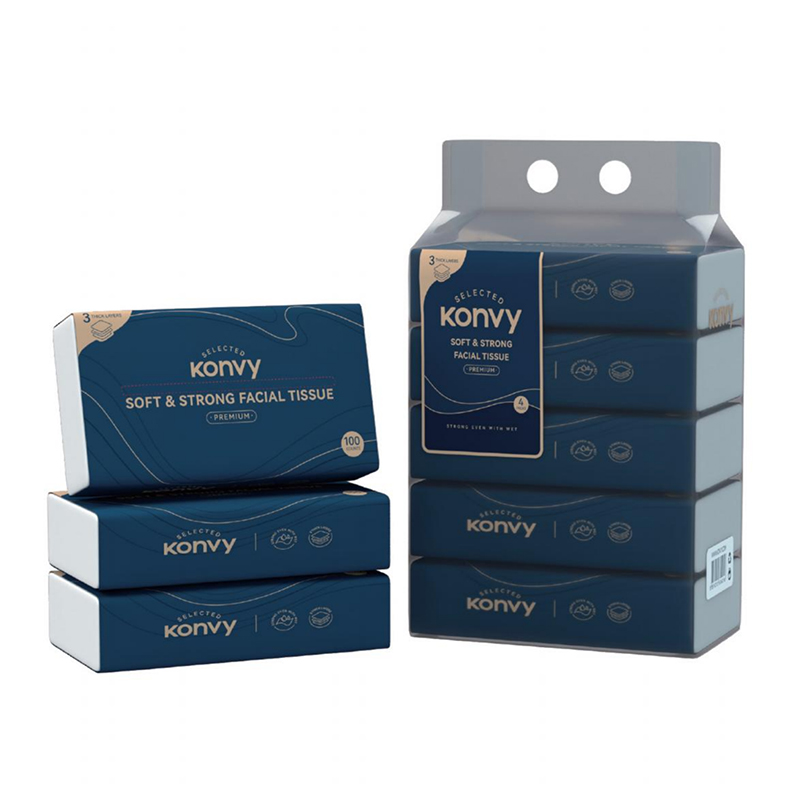 3-Ply Virgin Pulp Facial Tissue – 100 Sheets (200×175mm)This 3-ply facial tissue contains 100 sheets per pack, each measuring 200×175mm and made from virgin wood pulp with a gsm of 13.8. Each pack weighs 145g. Packing speci...View Product →
Softness comes from short hardwood fibers that lie flat and pack into a bulky sheet; strength comes from long softwood fibers that entangle into a load-bearing network. Blend ratio, not the additive package, is the first lever a mill pulls.
Ask for the furnish breakdown before you compare price. Two suppliers can quote the same ply count and the same sheet size while running very different fiber blends, and the gap shows up as 15 to 25 percent difference in tensile strength plus a visible difference in sheet caliper.
Additives usually make up less than 5 percent of a tissue sheet by weight, but they control whether the sheet holds together when wet, how fast it absorbs, and how it feels against skin.
A cream tissue typically carries 0.5 to 2 percent add-on of a glycol and fatty ester blend applied at the converting stage. It lifts measured softness scores, and it also lowers absorbency, which is why cream facial tissue and kitchen towel are never built from the same recipe.
Polyamide-epichlorohydrin (PAE) is the workhorse wet strength resin in kitchen towels and napkins, dosed around 0.3 to 1 percent of dry fiber. Wet strength is what stops a towel from disintegrating in a puddle. Toilet tissue deliberately uses little or none so the sheet disperses in water.
Cationic debonders interrupt the hydrogen bonding between fibers, which lowers tensile strength and raises perceived softness. Release agents and creping adhesives govern how the sheet leaves the Yankee cylinder, and that mechanical interaction accounts for much of the bulk in the finished product.
When you specify tissue for a hotel, clinic, or retail brand, request the additive schedule next to the safety data sheet. Wet strength resin levels and lotion add-on percentages explain more end-user complaints than ply count does.
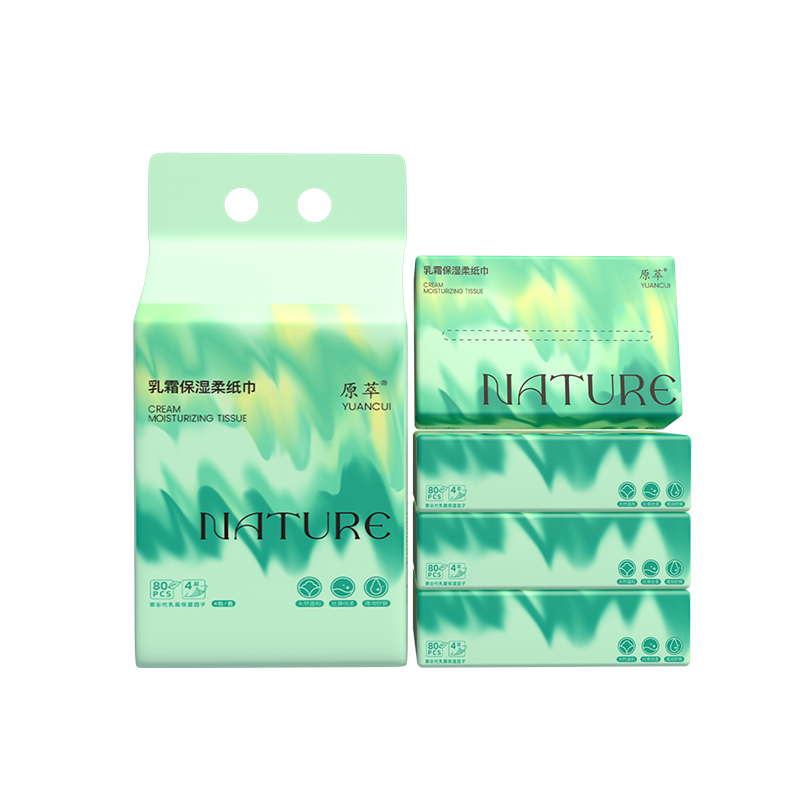 Disposable 80-sheet 4-layer cream moisturizing super soft facial tissueThe disposable 80-sheet 4-layer cream moisturizing super soft facial tissue adopts an advanced four-layer thickened design, which not only enhances the toughness and d...View Product →
Raw material becomes a tissue sheet through seven unit operations, and step six decides most of the softness a user feels.
A specification sheet tells you more than the front of the pack, because basis weight, ply count, fiber blend, and the additive list together explain nearly the whole price difference.
| Product | Typical furnish | Ply | Key additive | Basis weight |
| Facial tissue, box or soft pack | Hardwood-dominant virgin blend | 2 to 4 | Lotion, debonder, dry strength | 13 to 20 gsm |
| Toilet tissue, small roll | Mixed virgin or deinked pulp | 2 to 3 | Minimal wet strength | 15 to 22 gsm |
| Kitchen paper towel | Softwood-dominant | 2 to 3 | PAE wet strength resin | 20 to 28 gsm |
| Napkin and hand towel | Deinked or mixed pulp | 1 to 2 | Dry strength, embossing | 16 to 20 gsm |
| Wet wipes | Nonwoven, spunlace or airlaid | Not applicable | Binder, surfactant, preservative | 40 to 60 gsm |
Note the last row. Wet wipes are not tissue paper at all: they are nonwoven fabrics bonded by resin or hydroentangling, which is why flushability depends on the binder and the dispersion design rather than on fiber alone. Across the household tissue range from boxed facial tissue to hanging roll towels, ply count moves from 2 to 5 while basis weight stays inside a narrow window, and suppliers such as Jingde County Wanfang Articles Commodity Co., Ltd, which sells under the name Wanfang Paper, publish ply count, sheet count, and dimensions on every SKU so buyers have something concrete to check.
 5-Ply Premium Facial Tissue – 100 Sheets (185×200mm)This premium 5-ply facial tissue contains 100 sheets per pack, each measuring 185×200mm and made from virgin wood pulp with a gsm of 13.5. Each pack weighs 250g. Packi...View Product →
Pulp is 60 to 70 percent of the cost of a finished tissue product, so the furnish decision is commercial before it is technical.
Standard facial and toilet tissues are made from wood pulp, not cotton. A sheet labeled cotton-soft usually refers to a refined hardwood blend chosen for smoothness. Genuine cotton linter tissue exists, but it is a specialty product and rarely appears on a supermarket shelf.
Bamboo grows fast and can be harvested within three to five years, which reduces pressure on pulpwood plantations. Softness still depends on how the fiber is refined, and bamboo is usually blended with wood pulp to reach the tensile strength of a standard sheet. Judge a supplier on chain-of-custody documentation rather than on the plant name.
Fiber length and bonding do. Short hardwood fibers combined with debonder chemistry produce a soft, bulky sheet, while long softwood fibers refined harder produce a dense, strong one. Ply count, embossing, and creping then fine-tune the balance between the two.
In tensile strength and brightness, yes, by roughly 20 to 30 percent, because recycled fibers are shorter and carry residual ash. Absorbency differences are much smaller. Deinked pulp is a well-established furnish for kitchen towels, napkins, and mid-tier toilet tissue, while premium facial grades usually keep virgin fiber in the blend.



 English
 日本語
 русский
 Español
 عربى