
Our team is proud to offer on time guarantee and product guarantee to customer satisfaction.
Read MoreOpen an 80-sheet pack of wet wipes and you are holding two products in one: a nonwoven fabric engineered to keep its shape while soaking wet, and a water-based solution that accounts for roughly 70 to 80 percent of the pack weight. The question of what wipes are made of therefore has two answers that have to be read together, fiber and liquid. Softness, cleaning performance, shelf life and the flushability claim printed on the back all follow from how those two halves are built.
Four numbers describe most wipes sold worldwide: a 70/30 viscose-to-polyester fiber blend, a fabric weight between 40 and 80 gsm, a liquid share of 70 to 80 percent of the finished pack, and a finished pH between 4.5 and 7.0. Move any one of them and the product changes category, from a gentle baby wipe to a heavy-duty household cleaning wipe.
Content
A wet wipe is a nonwoven fabric, most commonly hydroentangled spunlace, saturated with a water-based formula and sealed inside a laminated film pack that slows moisture loss for up to 24 months.
Wipes are not paper, and that distinction answers most of the questions buyers actually ask. Tissue paper is built from wood pulp fibers held together by hydrogen bonds, which is why a plain facial tissue loses its strength the moment it gets wet. A wipe is built differently: staple fibers are laid into a web and bonded mechanically with high-pressure water jets, so the sheet keeps its tensile strength while it carries three or four times its own weight in liquid. The same structure is what prevents linting, resists tearing at the dispenser opening and allows the surface to be embossed, apertured or printed without falling apart.
For procurement teams, the practical consequence is that two packs with identical front labels can behave nothing alike. A 65 gsm spunlace wipe at 75 percent liquid load will clean a kitchen counter in one pass; a 40 gsm wipe with the same liquid grams will shred under the same pressure. Material specification, not the marketing line, decides the outcome.
The fiber blend, not the liquid, decides how a wipe feels in the hand and how it fails under pressure.
| Fiber | Typical share | What it does in the fabric |
| Viscose (rayon) | 50 to 70 percent | Softness, absorbency, high liquid retention |
| Polyester (PET) | 30 to 50 percent | Tensile strength, low lint, dimensional stability |
| Cotton | 5 to 100 percent | Softest hand feel, natural positioning, highest fiber cost |
| Wood pulp | 20 to 80 percent in airlaid | Fast absorbency, dispersibility, lower cost per sheet |
| PLA or bamboo | Varies by supplier | Compostability claims and shelf differentiation |
Spunlace lines typically run on staple fibers of 38 to 40 mm length and 1.4 to 1.7 dtex, fine enough to entangle into a soft surface but long enough to survive the water jets without washing out of the web. Airlaid lines work differently: they use short wood pulp fibers of 2 to 4 mm bonded with latex or bicomponent binder fibers, which is what makes a pulp-heavy wipe dispersible but also more paper-like to the touch. Viscose without polyester tears at the fold; polyester without viscose glides across skin like plastic film. That is why the blend exists at all.
Purified water makes up 90 percent or more of the liquid and roughly three quarters of the weight of the finished wipe. The rest is a short list of functional ingredients measured in fractions of a percent.
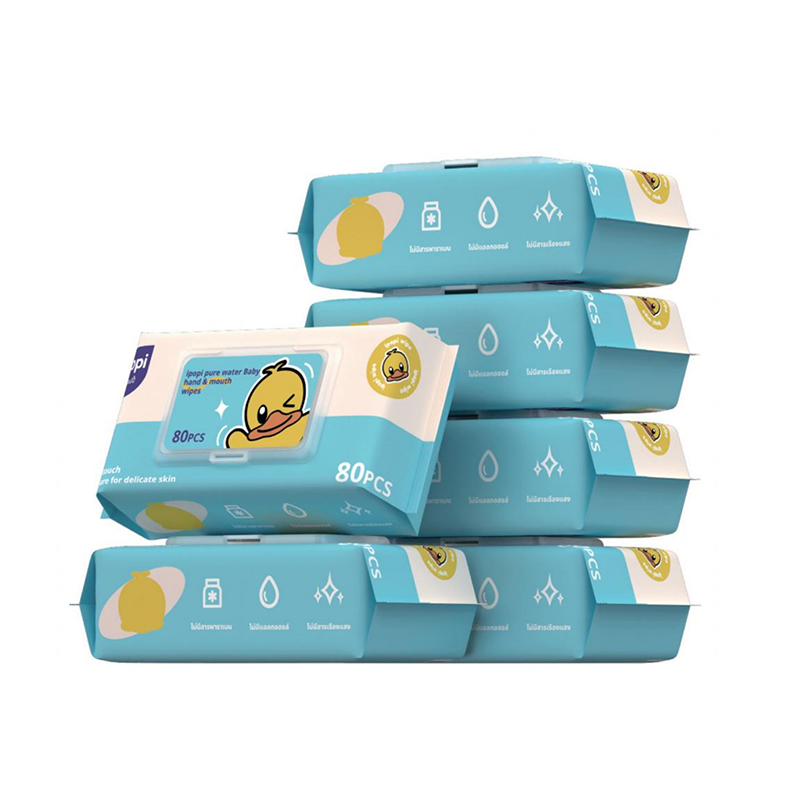 Pure Water Wet Wipes – 80 Sheets (140×180mm)This large-count pure water wet wipe pack contains 80 pre-moistened sheets per unit, each measuring 140×180mm. Made from a 10% viscose fiber and 90% polyester blend, t...View Product →
Wipe production runs on one continuous line, and the fabric is never dried back into a finished roll before liquid dosing. That single fact explains the tight tolerances on moisture and seal quality.
Line speed and dosing accuracy interact directly. Run the web too fast and the pickup weight drifts, so the top and bottom sheets of a pack differ noticeably in moisture. The full sequence is covered in more detail in this guide to how wet wipes are made, including the raw material decisions that sit upstream of the line.
Flushability is decided by fiber length and pulp content, not by how thin the wipe feels in your hand.
A dispersible wipe is engineered with short pulp fibers and deliberately low wet strength so it breaks apart under the shear forces inside a drain line. A standard 70/30 viscose-polyester spunlace wipe does the opposite: the polyester fraction holds the web together indefinitely. That is why the industry tests flushability against defined protocols such as the INDA and EDANA guidelines for assessing the flushability of disposable products, rather than relying on a label claim. The stakes are concrete. Surveys by United Kingdom water companies have attributed around 93 percent of the material in sewer blockages to wet wipes and congealed fats, which is why several markets now require a do-not-flush symbol on any wipe that has not passed dispersibility testing.
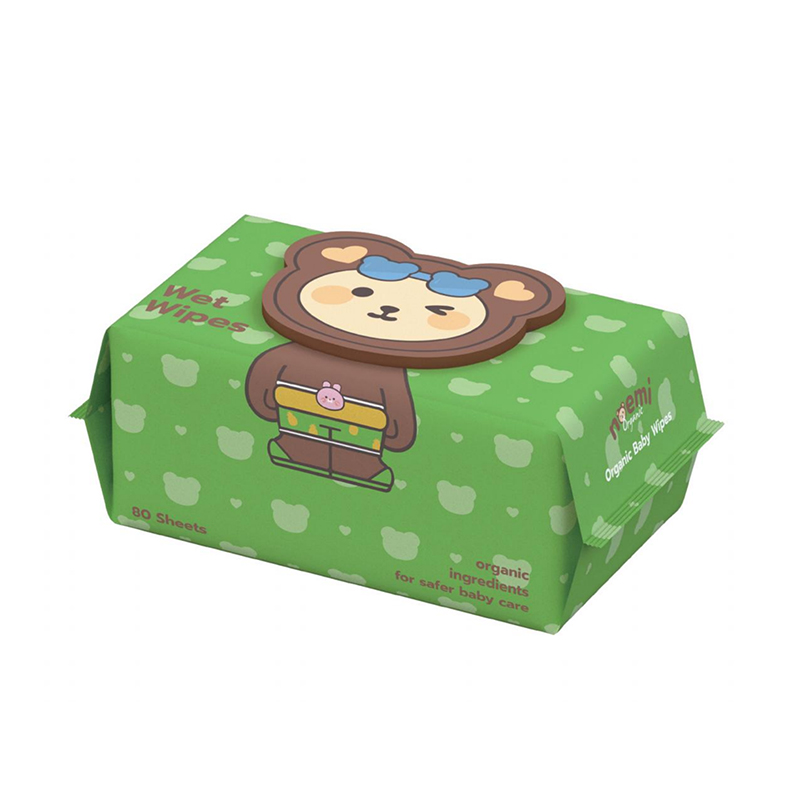 Organic Flushable Wet Wipes – 80 Sheets (150×200mm)This large-count organic wet wipe pack contains 80 pre-moistened sheets per unit, each measuring 150×200mm and made from dissolvable wood pulp for flushable disposal. ...View Product →
Read the fiber description on the back label before you read the front, because the front is written by marketing and the back is written by the mill.
A short checklist covers most purchasing decisions:
Manufacturers that run their own spunlace and converting lines can adjust fiber ratio, weight and liquid load as separate variables rather than selling whatever is already on the roll. Jingde County Wanfang Articles Commodity Co., Ltd, which trades as Wanfang Paper, produces across the tissue, wet wipe and facial towel categories, including the pure water, antibacterial and flushable formats discussed here. Buyers who need a specific blend, sheet size or liquid load can review the wider wet wipes range and request specification sheets before committing to a container order.
 20-pack antibacterial alcohol-free baby wipesThe 20-pack antibacterial alcohol-free baby wipes are specially formulated for infants and young children , whose skin is naturally delicate and highly sensitive to ir...View Product →
Most are partly plastic. Polyester, chemically identical to PET, is a plastic fiber and usually makes up 30 to 50 percent of a spunlace wipe. Viscose is a regenerated cellulose fiber and is not plastic. A 100 percent pulp airlaid wipe or a 100 percent cotton wipe contains no plastic fiber at all, though the laminated film packaging almost always does.
A paper towel is wood pulp bonded by hydrogen bonds and reinforced with wet-strength resin, so it absorbs water but loses strength as it saturates. A wet wipe is a nonwoven fabric whose fibers are entangled mechanically, so it arrives already saturated and keeps its tensile strength while wet.
No. Alcohol appears mainly in disinfectant and hand sanitizing wipes, where it acts as both an antimicrobial and a preservative. Baby wipes, facial wipes and personal care wipes are typically alcohol-free because alcohol dries and irritates skin. Check the ingredient list for ethanol or alcohol denat if dryness is a concern.
A sealed pack holds its moisture for around 24 months, and some formats reach 36 months. Once opened, the adhesive label is the weak point: air exchange through a partially resealed lid can dry the top sheets within a few weeks. Storing the pack lid-down slows that loss noticeably.




 English
 日本語
 русский
 Español
 عربى