
Our team is proud to offer on time guarantee and product guarantee to customer satisfaction.
Read MoreTissue paper is a lightweight creped sheet built between 12 and 40 grams per square metre, dried on a Yankee cylinder and sold for single-use hygiene, wiping and food service.
That grammage band is the practical dividing line in the trade. Below it, the sheet can be creped to build stretch, bulk and absorbency. Above it, the same furnish starts to behave like a light packaging paper and loses the hand-feel buyers pay for.
The category is also large enough that specification drift gets expensive. Industry estimates put global tissue consumption above 44 million tonnes a year, and mills grade each batch against the ISO 12625 test series rather than against brochure language.
A mill that runs both dry tissue and wet wipes tests the same furnish against two different acceptance limits, and the results rarely travel together. Short background notes on tissue paper facts cover the fibre and hygiene side of that split.
Content
ISO 12625-1 sets the vocabulary for the tissue category, and the rest of the ISO 12625 series fixes the test methods that decide whether a shipped pallet matches the approved sample.
The working parts are ISO 12625-3 for thickness and apparent bulk, part 4 for dry tensile strength, part 5 for wet tensile strength, part 6 for grammage, part 8 for water absorption time and capacity, and part 9 for ball burst strength. A supplier who quotes premium softness without a grammage figure and a wet tensile number is quoting an opinion.
On the machine, stock arrives at well under one percent fibre consistency, forms on a wire or a through-air fabric, is pressed, dried on a steam-heated Yankee cylinder, then creped off the surface by a doctor blade. Crepe ratio, normally 15 to 30 percent, is the physical source of stretch. A sheet creped at 20 percent extends roughly a fifth of its length before it tears, which is why it conforms to a hand instead of splitting under it.
Tissue paper is a paper grade below roughly 40 g/m2, creped at 15 to 30 percent off a Yankee cylinder, with softness, absorbency and wet strength engineered for one use cycle.
Three traits follow from that process. The sheet stays bulky because it is creped rather than calendered hard, it carries very little mineral filler compared with printing paper, and kitchen and toilet grades add starch, carboxymethyl cellulose or a wet strength resin to hold structure once wet.
Four families account for the bulk of household and commercial tissue volume: toilet tissue, facial tissue, kitchen towels, and napkins or hand towels, each specified on a different ply count and sheet format.
| Family | Common ply | Sheet format | Performance priority |
| Toilet tissue | 2 to 3, up to 5 | 100 x 110 mm to 120 x 100 mm sheets | Perforation strength, dispersibility |
| Facial tissue | 2 to 4 | 180 x 140 mm to 200 x 200 mm | Softness, lint level |
| Kitchen towel | 2 to 3 | 200 x 200 mm to 230 x 225 mm | Wet strength, absorption rate |
| Napkin or hand towel | 1 to 2 | 200 x 200 mm interfolded to 270 x 270 mm | Fold retention, food contact |
Kitchen towel is the only family routinely specified above 30 g/m2 per ply. Below that threshold, wet strength becomes the limiting property before absorbency does.
The mill's tissue paper range covers all four families in boxed, bagged, hanging and roll formats. Sheet counts run from 30 to 320, sheet sizes include 180 x 140 mm, 193 x 200 mm and 200 x 200 mm, and boxed facial tissue is offered with custom print for private label programmes.
A 3-ply, 100-sheet box at 180 x 180 mm is the compact format hotels and offices order when drawer space is fixed.
 3-Ply Compact Box Facial Tissue, 100 SheetsThis 180×180 mm boxed tissue offers 100 three-ply virgin-pulp sheets in a compact format suited to desks, cars, and smaller spaces.View Product →
Fiber sets the ceiling on strength and softness: bleached virgin kraft softwood gives the highest tensile and tear values, recycled deinked pulp lowers fiber cost and brightness, and bamboo furnishes land between the two.
Blending is the normal answer. A 60 to 40 softwood to hardwood ratio is the standard facial tissue furnish, because long softwood fibres carry strength while short hardwood fibres pack evenly and smooth the surface.
Bamboo furnishes behave close to hardwood in length and deliver higher bulk, but they cost more than mixed recycled pulp and need separate food contact verification before they enter napkin or hand towel lines.
Five numbers explain most quality gaps between two packs with identical artwork: grammage per ply, ply count, sheet count, moisture content and wet tensile strength.
Read the chart as a mass map. A kitchen towel at 20 to 40 g/m2 per ply carries roughly double the fiber of a napkin at 15 to 18 g/m2, and that extra mass is what lets it hold water without collapsing.
A 120-sheet virgin pulp kitchen roll at 225 mm width suits retail programmes that fix sheet count per roll rather than roll weight.
 Virgin Pulp Kitchen Towels, 120 Sheets per RollThese 2-ply virgin-pulp kitchen rolls provide 120 sheets at 225×115 mm for everyday spill absorption and surface cleaning in fixed-sheet retail programmes.View Product →
Two compliance questions decide which channel a tissue product can enter: whether it disperses after flushing, and whether it is safe for direct food contact.
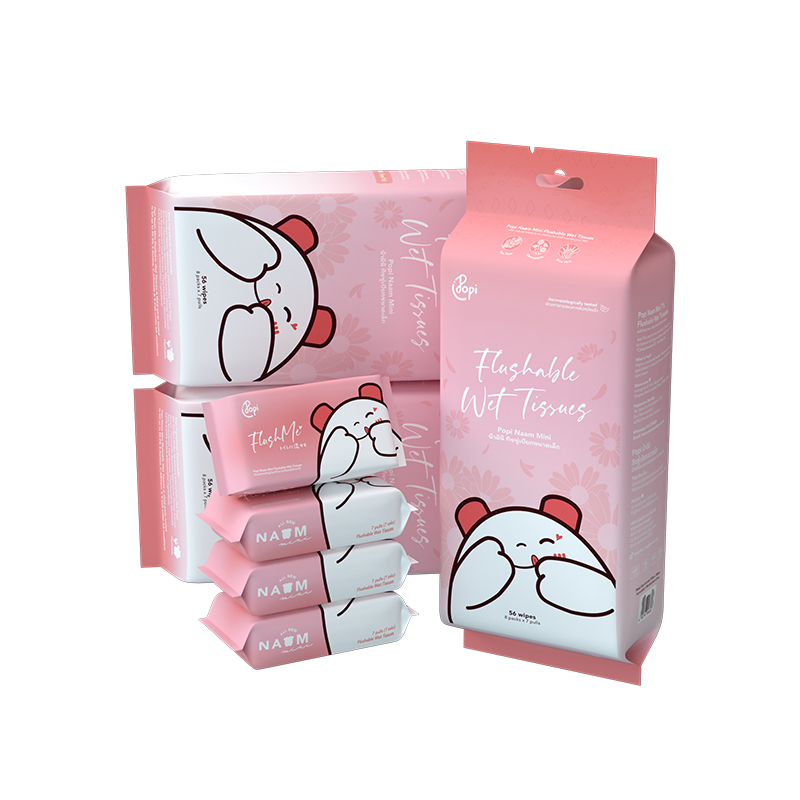
Flushable tissue and wipes are assessed under the INDA and EDANA GD4 guidelines, which combine a toilet bowl clearance test, a drain line transport test and a laboratory disintegration test. A product sold as flushable has cleared all three. A standard wet wipe has not, which is why most wipe packs carry a bin symbol instead.
Napkins and hand towels used in food service fall under FDA 21 CFR 176.170 in the United States and Regulation (EC) 1935/2004 in the European Union. Both routes require a declaration of compliance that names the wet strength resin and confirms the absence of banned optical brighteners.
Neither gate is negotiated at the packaging stage. Furnish and additive choices lock the answer months earlier, so buyers who need a flushable or food contact grade should raise it before sampling, not after.
Four numbers and one document belong in every bulk tissue inquiry: grammage with tolerance, ply count, sheet count with tolerance, moisture content, and a batch certificate of analysis.
Wanfang Paper, registered as Jingde County Wanfang Articles Commodity Co., Ltd, states an on-time delivery guarantee and a product guarantee, lists automated production lines, and runs a direct-sale showroom in Jingde County, Anhui, where buyers can compare sheet formats before ordering. Inquiries reach the sales team on +86-400-031-1119.
A disposable virgin wood pulp small roll is the usual first item in a private label trial, because it tests furnish quality without the cost of printed packaging.
 Disposable Virgin Wood Pulp Small Roll Toilet PaperMade from virgin wood pulp with multi-layer embossing, these small rolls suit bathrooms, office drawers, and public restrooms while using less storage space.View Product →
No. Toilet paper is one product built from tissue paper. Toilet tissue runs 15 to 20 g/m2 per ply at 2 to 3 plies and is engineered to break up in water, while facial tissue runs 14 to 22 g/m2 per ply and is engineered to stay intact when wet.
Three plies at 15 to 18 g/m2 per ply sit inside typical retail and hotel specifications. Four and five-ply builds exist mainly for premium positioning, where measured softness matters more than cost per sheet.
No. Grammage per ply measures fiber mass, not softness. Two 3-ply packs at 16 g/m2 per ply can differ in tensile strength and hand-feel once softwood content, crepe ratio and embossing pattern diverge.
Clean, unused tissue paper is recyclable as mixed paper, and deinked recycled pulp is a standard tissue furnish. Soiled tissue is not recyclable through paper streams and belongs in general waste or in a compost scheme that accepts it.



 English
 日本語
 русский
 Español
 عربى