
Our team is proud to offer on time guarantee and product guarantee to customer satisfaction.
Read MoreA three-ply facial tissue sheet carries roughly 45 grams per square metre in total, yet it still tears between your fingers the moment it is wet. That gap between how little material there is and how much work the sheet performs is the reason buyers open a specification sheet and look for one line first: what is tissue paper made of. The answer is short, verifiable and usually printed on the carton.
Content
Tissue paper is made of cellulose fiber, water and a small quantity of functional chemistry. Wood pulp supplies 70 to 95 percent of the dry sheet; softwood fibers of 2 to 4 mm carry the tensile strength that keeps a sheet from disintegrating on a high-speed machine, hardwood fibers of 0.7 to 1.5 mm supply softness, formation and opacity, and 1 to 5 percent of additives control wet strength, handfeel, whiteness and colour.
Tissue paper is a low-grammage paper of 12 to 30 gsm per ply, built from cellulose fibers bonded by hydrogen bonds formed during drying, with 1 to 5 percent functional additives and 5 to 8 percent residual moisture at packing.
The fiber line is where quality is actually decided. A furnish of 100 percent virgin bleached kraft pulp is a different product from a blend of 70 percent virgin and 30 percent deinked recycled fiber, even when both are sold as a three-ply soft pack with the same sheet count. Background on how pulp grades are classified for household paper is collected in this overview of tissue paper fundamentals.
Every tissue grade, from a two-ply toilet roll to a five-ply facial tissue, is built from the same four material groups. What changes between grades is the ratio, never the ingredient list.
| Material group | Share of sheet | Function |
| Softwood kraft pulp | 25-45% | Long fiber for tensile strength and machine runnability |
| Hardwood kraft pulp | 40-65% | Short fiber for softness, formation and opacity |
| Recycled or non-wood fiber | 0-100% | Cost control, source reduction, bamboo and bagasse options |
| Functional chemistry | 1-5% | Wet strength, softener, lotion, brightness, colour |
| Water | 5-8% residual | Plasticises fiber during drying so hydrogen bonds form |
Non-wood fibers follow identical logic. Bamboo and bagasse pulps sit in the 1.5 to 2.5 mm range and behave close to a hardwood blend, which is why they appear in plant-fiber facial towels rather than in high wet-strength kitchen rolls. Cotton linter pulp runs 88 to 96 percent alpha-cellulose and reaches a white sheet with minimal bleaching, the reason cotton facial towels are specified for sensitive-skin use.
Typical mill furnish ranges. Higher hardwood content raises softness and lowers wet tensile strength.
Recycled fiber changes brightness, strength and price, not hygiene. Deinked pulp reaches an ISO brightness of 80 to 86 percent against 88 to 92 percent for bleached virgin kraft, and each additional recycling cycle shortens average fiber length, costing roughly 10 to 20 percent of tensile strength per pass.
The choice is normally made per SKU rather than per brand. A single converting line can run virgin facial tissue in the morning and recycled kitchen towels in the afternoon, which is why the furnish declaration on the carton matters more than the supplier's general marketing claim.
 High-Absorbency Plant Fiber Paper Towels for Sensitive SkinPlant-based towels with fast moisture locking, no fluorescent agents or artificial fragrances, and skin-contact suitability; useful when comparing SKU-level furnish and additive choices.View Product →
Additives occupy 1 to 5 percent of a tissue sheet by weight and determine whether a kitchen roll holds a spill or a facial tissue feels dry against the nose. Formulators treat them as the fine adjustment layer on top of the fiber blend.
Lotion adds weight, not strength. A 17 gsm sheet carrying 1.2 g per square metre of lotion feels heavier in the hand than the same base sheet without lotion, yet tests lower in dry tensile because the film interrupts fiber bonding.
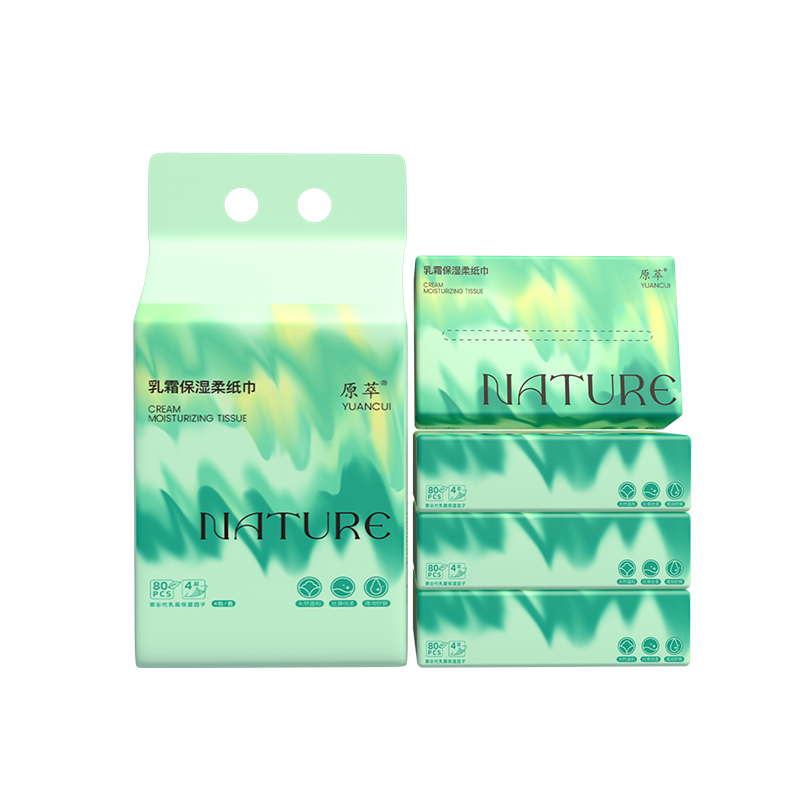 Four-Layer Cream Moisturizing Facial Tissue, 80 SheetsPortable four-layer tissue with added cream moisturizers for softness and moisture retention; suits daily cleaning, baby care, and frequent cold-season use.View Product →
Conversion is continuous: a 3 to 5 percent consistency slurry enters one end of the machine and leaves as a 5 to 8 percent moisture sheet in under three minutes on a modern crescent-former line.
Crepe ratio deserves attention when comparing quotations. A 20 percent crepe gives stretch, bulk and softness, while 12 percent gives a denser and stronger sheet. Two suppliers can quote identical grammage and deliver a visibly different handfeel purely through crepe ratio and embossing pattern.
Six numbers separate a workable quotation from an expensive one, and all six should appear in writing before a sample is approved. Full ranges by category sit in the tissue product range listing.
| Specification | Typical value | Why it matters |
| Grammage | 13-18 gsm per ply (facial), 16-22 gsm (kitchen) | Thickness, opacity and cost per sheet |
| Ply count | 2 to 5 plies | Absorbency, bulk, wet strength |
| Sheet size | 180 x 140 mm to 200 x 200 mm | Coverage against paper waste |
| Wet tensile, MD | 100-300 N/m for towels | Break-up behaviour versus durability |
| Crepe ratio | 15-25% | Stretch, softness and bulk |
| Residual moisture | 5-8% | Mould risk in transit, handfeel |
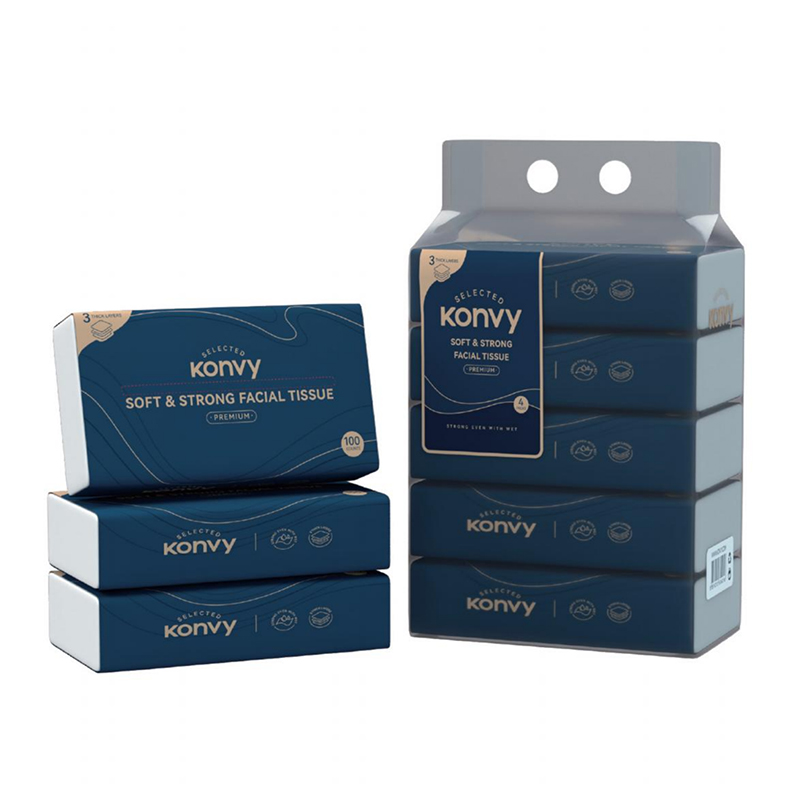 3-Ply Virgin Pulp Facial Tissue, 100 Sheets, 200×175mmA 100-sheet, 13.8 gsm three-ply virgin pulp tissue in 200×175mm sheets; its stated furnish, ply count, and size make quotations easier to compare.View Product →
A 100-sheet three-ply virgin pulp facial tissue at 200 x 175 mm is a useful benchmark: it shows how a declared furnish, ply count and sheet size translate into a firm quotation, and it makes a weak offer visible in one comparison.
Yes. Bleached kraft wood pulp is the base of the large majority of household tissue sold worldwide. A box marked 100 percent virgin pulp contains wood-derived cellulose fiber plus 1 to 5 percent additives and 5 to 8 percent water, with no other structural ingredient.
Yes, when deinking and screening are controlled. Recycled pulp is deinked, dispersed and screened, then tested for brightness at 80 to 86 percent ISO and for microbiological load, and the finished sheet is verified under the ISO 12625 test series used for virgin tissue.
Plant fiber means non-wood cellulose, usually bamboo, bagasse or cotton linter. Bamboo fiber averages 1.5 to 2.5 mm in length, close to a hardwood, while cotton linter reaches 88 to 96 percent alpha-cellulose and delivers the lowest lint level of the three.
Because the extra ply creates internal interfaces. Three plies at 13 gsm give 39 gsm total with two trapped air layers, and those layers lower heat transfer to the skin, so the sheet reads as warmer and thicker than a two-ply 19 gsm sheet of 38 gsm total.



 English
 日本語
 русский
 Español
 عربى