
Our team is proud to offer on time guarantee and product guarantee to customer satisfaction.
Read MoreThe material that makes up a wet wipe determines everything from how well it cleans to whether it will clog a drain or persist in a landfill. While the liquid formulation gets most of the attention, the substrate—the fabric that holds the liquid—is the true engineering core. Most wipes rely on a nonwoven fabric produced through processes such as spunlace, airlaid, or thermal bonding, with fiber selection ranging from petroleum-based polypropylene to plant-based lyocell. Understanding these material layers lets you match the wipe precisely to its intended job, whether that is disinfecting a medical surface, cleaning heavy grease in an industrial facility, or providing a truly biodegradable personal care option.
Content
A practical way to classify wet wipes types is by the fiber composition and bonding method of the substrate. This classification connects directly to the wipe's strength, absorbency, and end-of-life profile.
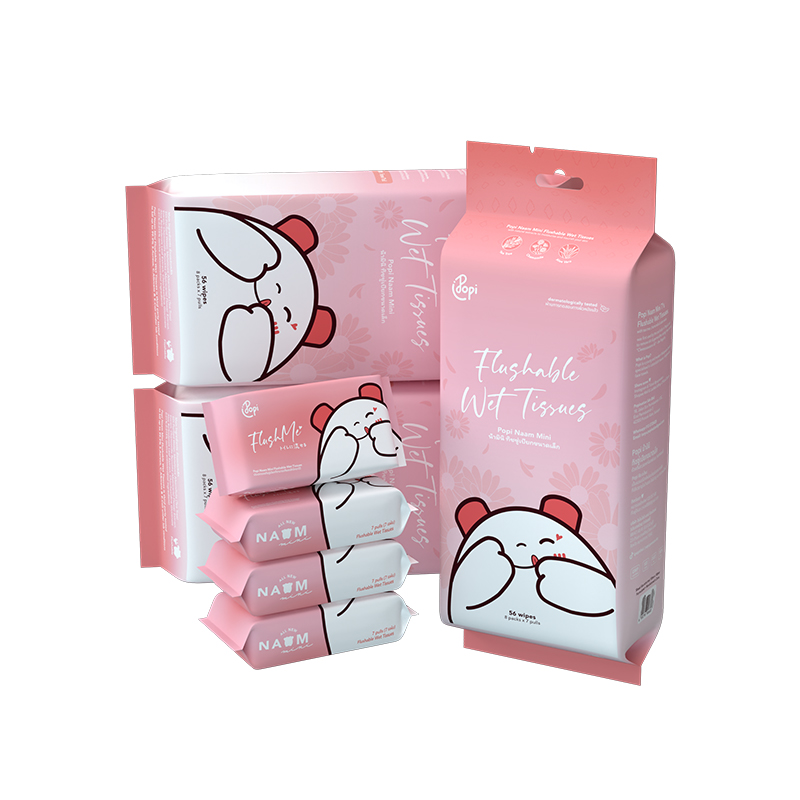
Directly answering what are wet wipes made of requires looking beneath the surface. A finished wet wipe consists of two components: the liquid formula (which can be water-based, alcohol-based, or loaded with emulsifiers and preservatives) and the substrate. The substrate is overwhelmingly a type of nonwoven fabric for wet wipes—a sheet material produced directly from fibers without spinning into yarn or weaving. This nonwoven structure provides the porosity needed to hold liquid, the tensile strength to resist tearing during use, and the surface texture required for effective cleaning.
The fibers themselves fall into three broad categories: synthetic (polypropylene, polyester, polyethylene), regenerated cellulose (viscose rayon, lyocell), and natural (cotton, wood pulp). A typical spunlace nonwoven wet wipe blends approximately 50–70% polyester for strength with 30–50% viscose for softness and absorbency. For a strictly biodegradable wet wipes material profile, manufacturers replace the polyester content with lyocell, modal, or cotton fibers, achieving full biodegradation under controlled composting conditions. In contrast, industrial wipes often use 100% polypropylene for maximum chemical resistance.
Spunlace technology accounts for roughly 60% of the global wet wipes substrate market according to industry production data, owing to a unique balance of drape, softness, and cost. The process uses no chemical binders—only water—which leaves the fiber surface free to absorb liquids and makes it inherently lint-free. This characteristic is non-negotiable for medical wet wipes materials, where fiber shedding onto a surgical site or instrument tray poses a contamination risk. Spunlace also allows precise adjustment of the ratio between synthetic and natural fibers, making it the primary platform for developing biodegradable wet wipes materials.
| Fiber Type | Biodegradability | Common Application |
|---|---|---|
| Polyester / Polypropylene | No | Disinfectant wipes, industrial heavy-duty wipes |
| Viscose Rayon | Yes (in soil and marine conditions) | Baby wipes, personal care wipes |
| Lyocell (TENCEL™) | Yes (fully compostable) | Premium biodegradable and flushable wipes |
| Wood Pulp / Cellulose | Yes | Flushable wipes, airlaid industrial wipes |
| PLA (Polylactic Acid) | Compostable under industrial conditions | Niche eco-brand wipes |
The evolution toward plant-based substrates has accelerated as regulations on single-use plastics tighten. Fully biodegradable spunlace constructed from lyocell or a viscose-wood pulp blend can break down by over 90% within 12 weeks in compost environments, based on ISO 14855 biodegradation testing. The trade-off is cost: lyocell-based wet wipes materials are typically 2–3 times more expensive than standard polyester-viscose blends, which keeps them in the premium segment for now.
The comparison of alcohol wipes vs disinfectant wipes is not simply about the active ingredient—it is about which substrate can deliver that chemistry without degrading. Alcohol wipes, typically saturated with 70% isopropyl alcohol, require a nonwoven that remains stable when saturated with a strong solvent. For this reason, they almost always use 100% polypropylene or a high-polyester spunlace blend, because viscose and wood pulp fibers swell and lose strength when soaked in alcohol. Alcohol-soaked wipes are used where rapid evaporation and a residue-free surface are priorities: wiping smartphone screens, prepping skin before an injection, or cleaning electronics.
Disinfectant wipes, in contrast, carry quaternary ammonium compounds (quats), hydrogen peroxide, or sodium hypochlorite solutions. These formulations are usually water-based, which means the wipe can incorporate a higher percentage of viscose or cellulose to boost absorbency and solution release. The critical material requirement here is chemical compatibility over extended contact time; a disinfectant wipe sitting in a canister for months must not lose strength or generate extractives that neutralize the active biocide. As a result, premium disinfectant wipes often use a coform or airlaid substrate treated with a binder system that withstands the pH of the disinfectant solution. In practical terms, if you see a wipe that claims a 3-minute kill against C. difficile spores on a medical surface, the substrate has passed stringent material integrity tests to ensure it stays intact during that required dwell time.
The phrase flushable wipes materials represents one of the most tightly regulated areas in the nonwovens industry. To be labeled flushable, a wipe must pass the GD4 dispersibility test defined by INDA/EDANA, which requires the sheet to break apart in agitated water within a specified timeframe. Achieving this while still delivering a wipe that doesn't disintegrate inside the package demands a precisely engineered fiber matrix.
The substrate typically uses a wetlaid process with a blend of 60–80% wood pulp and 20–40% regenerated cellulose or extremely short-cut synthetic fibers. The pulp provides the bulk and absorbency, while the longer fibers generate wet strength through hydrogen bonding and light entanglement rather than through binders that would prevent breakdown. Once submerged and agitated in wastewater, the hydrogen bonds release and the fibers separate. Some higher-end flushable products substitute lyocell for the synthetic component, yielding a wipe that is both dispersible and fully biodegradable. It's worth noting that a wipe claiming to be "biodegradable" is not automatically flushable—biodegradability refers to microbial breakdown over weeks or months, while flushability demands mechanical dispersion in seconds. The two properties require different material solutions.
The range of disposable wipes applications spans from gentle skin contact to heavy manufacturing, and the material requirements diverge sharply at the extreme ends. Industrial wet wipes applications—think printing press cleanup, automotive degreasing, or wiping down CNC machines—demand high abrasion resistance and solvent tolerance. These wipes are often made from meltblown or spunbond polypropylene, sometimes with a diamond embossed pattern that enhances scrubbing efficiency. Surface texture matters as much as chemistry: a smooth spunlace sheet will slide over caked-on grease, whereas a thermally bonded textured sheet can scrape it loose.
For medical wet wipes materials, the priorities invert. The fabric must be lint-free, non-sensitizing, and free of extractables that could cause irritation or interfere with disinfectant efficacy. Medical-grade spunlace made from polyester-viscose or pure cotton is standard, often sterilized via gamma radiation or ethylene oxide before use in surgical prep or patient cleansing. The ISO 10993 biocompatibility standard applies here, imposing limits on cytotoxicity, skin irritation, and systemic toxicity. A sub-par nonwoven that sheds microfibers onto a wound site can trigger foreign body reactions, which is why material certifications are non-negotiable in procurement specifications for healthcare facilities.



 English
 日本語
日本語 русский
 Español
 عربى
عربى