
Our team is proud to offer on time guarantee and product guarantee to customer satisfaction.
Read MoreKitchen paper either holds together when it meets a puddle of cooking oil or it collapses into wet pulp in your hand, and that outcome is settled at the paper mill rather than at the sink. Base-sheet grammage, wet-strength chemistry, ply count and embossed pattern are the four variables that separate a roll which wipes a stove clean from one that smears fibre across it.
Kitchen paper - kitchen roll in British usage, kitchen towel in foodservice catalogues - is a disposable absorbent sheet built specifically for picking up water and oil. It is not a thicker grade of facial tissue. It belongs to a separate product family with its own fibre blend, its own chemical additive and its own set of factory tests.
Content
Kitchen paper is a disposable absorbent sheet made from wood pulp, usually 2 to 3 plies thick, with a base-sheet grammage of roughly 20 to 24 gsm and a wet-strength additive that keeps the sheet from disintegrating once it is saturated.
Scott Paper introduced the first commercial paper towel in 1931 as a hygienic replacement for the shared cloth roller towel in restaurant washrooms. The household roll followed in the decades after, and the category split into two branches: lighter sheets for hand drying and heavier embossed sheets for spill and grease work.
In British English, kitchen paper means absorbent kitchen roll. Translation pages and dictionary entries often blur the term with baking parchment or greaseproof paper, which are silicone-coated and deliberately non-absorbent. A quotation that says kitchen paper without stating grammage, ply count and wet-strength grade cannot be compared against another quotation, because those three numbers carry the entire performance difference.
Kitchen paper gets its durability from two things working together: long-fibre softwood pulp and a wet-strength resin that prevents fibre bonds from dissolving in water.
Virgin softwood pulp carries the longest fibres, and long fibres are what allow a saturated sheet to keep its shape. A well-formed virgin-pulp kitchen sheet will typically lift several times its own weight in water before it begins to break apart under its own load. Recycled furnishes are shorter in fibre and lose tensile strength quickly when wet, so they are normally blended with virgin pulp or reserved for lighter wiping grades.
Two-ply is the working standard for household rolls, and three-ply adds a middle layer that raises bulk and absorbency without adding much weight. Embossing earns its place twice over: it opens surface area for capillary uptake, and it mechanically locks the plies together so a wet sheet does not split when it is pulled from the roll. That absorption behaviour is measurable, and mills test for it, as this analysis of kitchen paper fibre structure and liquid uptake sets out in detail.
Hanging formats, such as a 200-sheet virgin pulp kitchen paper towel with 200 x 200 mm sheets, solve a different problem: the roll stays off the counter and dispenses one sheet at a time, which reduces both moisture pickup and waste in a working kitchen.
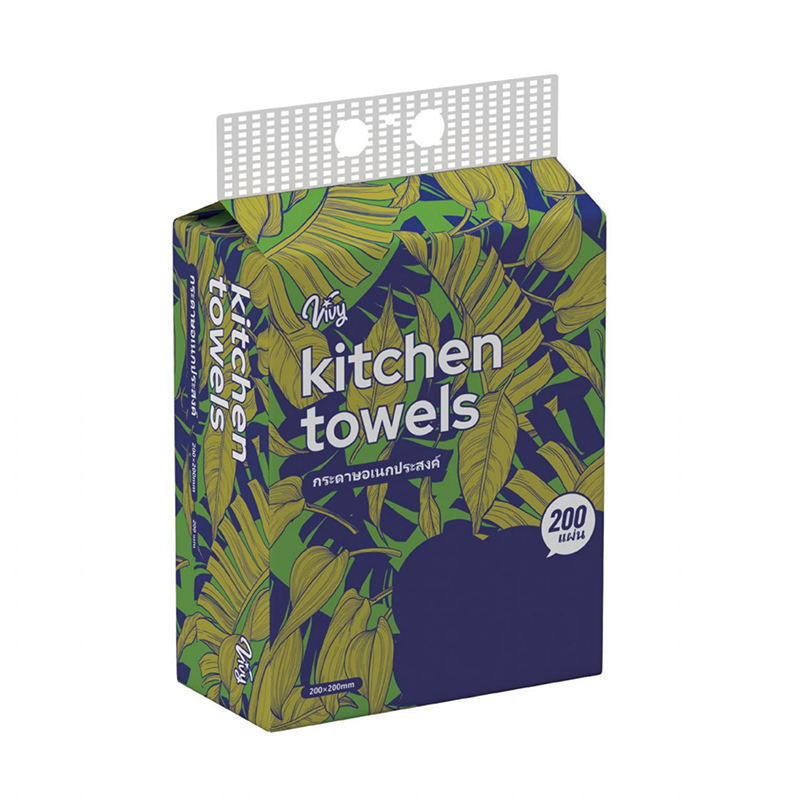 Hanging Virgin Pulp Kitchen Paper Towels – 200 Sheets (200×200mm)These hanging-format kitchen paper towels are made from 2-ply virgin wood pulp, providing reliable absorbency and strength for kitchen wiping tasks. Each pack contains...View Product →
Kitchen paper is the heaviest and wettest sheet in the household paper family, while napkins, facial tissue and toilet paper are built lighter and with far less wet strength because their jobs never involve standing up to liquid.
| Product | Grammage (gsm) | Plies | Wet strength | Primary use |
| Kitchen paper roll | 20-24 | 2-3 | High | Spills, grease, counter wiping |
| Kitchen paper towel | 20-24 | 2-3 | High | Hand drying, food preparation lines |
| Paper napkin | 15-18 | 1-2 | Low | Dining, lap protection |
| Facial tissue | 13-18 | 2-3 | Very low | Face and nose care |
| Toilet paper | 13-16 | 2-3 | Low | Bathroom hygiene |
Two practical consequences follow. First, food contact: sheets used to blot fried food or line a tray should arrive with a food-contact declaration from the mill, because migration limits for paper and board differ between the European Union and the United States. Second, wet strength cuts both ways, since the resin that keeps a sheet intact also slows its breakdown in water, which is why ordinary kitchen paper should never be treated as flushable.
Kitchen paper wins on fast, small-volume liquid pickup and loses on anything that demands volume handling, abrasion resistance or repeated use.
Lint level is the specification left out of most quotations, and it decides whether a roll is acceptable for glassware and stainless. A lint-free disposable kitchen paper towel is the grade to specify for optical surfaces, mirrors and food display cases, where loose fibre shows up immediately.
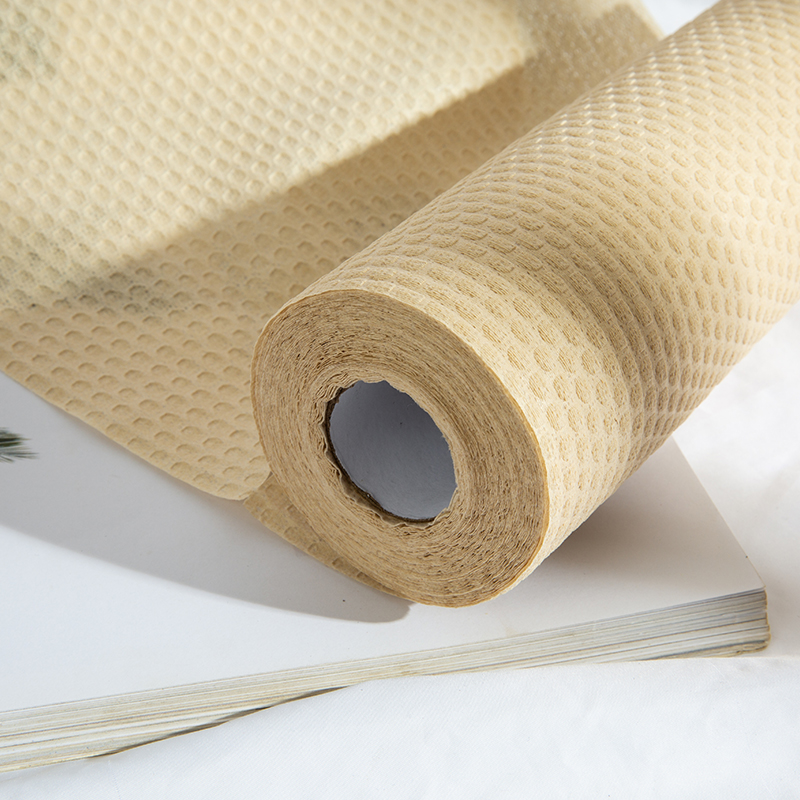 Lint-Free Disposable Kitchen Paper Towels for Household CleaningThe Lint-Free Disposable Kitchen Paper Towels for Household Cleaning are crafted from high-quality virgin wood pulp to deliver superior strength, softness, and absorpt...View Product →
Compare kitchen paper on cost per square metre and wet tensile strength, not on roll count or price per pack, because sheet size and ply structure move the real cost far more than the headline number on the label.
A roll of 200 sheets at 200 x 200 mm delivers 8 square metres of wiping surface. A 120-sheet roll with 225 mm sheets delivers 6.1 square metres. Price per roll hides that gap completely.
General household use sits at 20 to 22 gsm, heavy-duty kitchen work at 24 gsm and above. Below 18 gsm the product is a hand towel that happens to be sold on a kitchen roll.
Ask for wet tensile as a percentage of dry tensile. High wet strength means the sheet survives a soaked wipe, and it also means the sheet resists breaking down in drains.
Point-to-point embossing produces a rougher wiping surface with strong ply bonding. Nested embossing produces a smoother sheet. Ask which pattern is used before comparing softness claims between suppliers.
Request a food-contact declaration, fibre sourcing documentation and, for flushable claims, the specific test standard the claim relies on. Buyers who prefer to inspect sheet size and embossing before committing to volume can arrange a visit through the direct-sale store showroom.
One commercial warning closes the list: sheet count inflation is common in promotional packaging, where a thinner sheet and a smaller sheet are combined to keep the roll count high. A water and oil absorbing household kitchen paper roll with a declared sheet dimension and ply count is the only kind of offer that can be benchmarked line by line against a competing quotation.
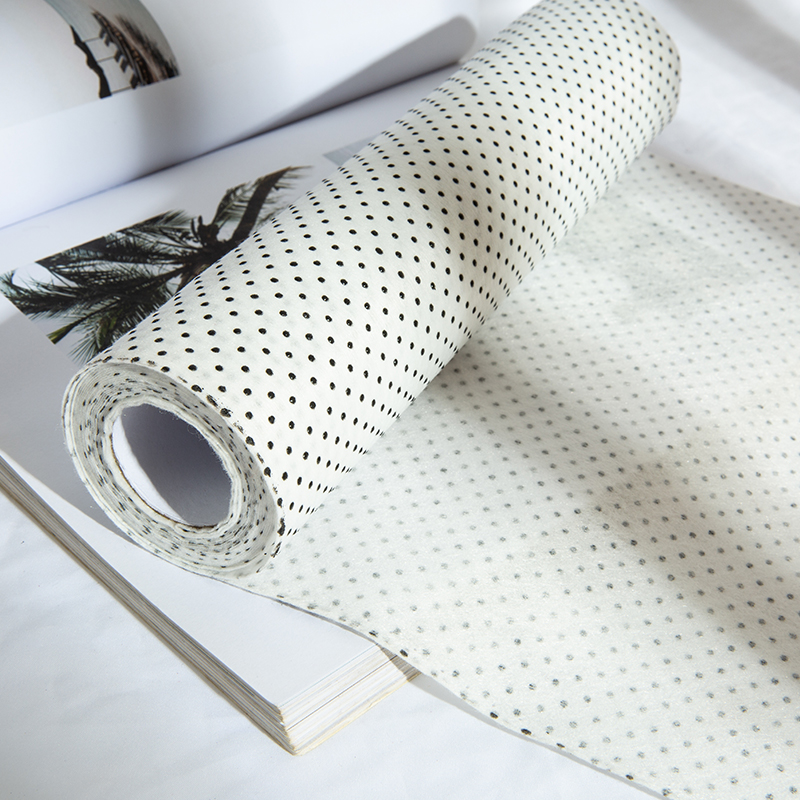 Durable Multi-Layer Water & Oil Absorbing Household Kitchen Paper RollThe Durable Multi-Layer Water Oil Absorbing Household Kitchen Paper Roll is a high-performance cleaning essential designed for modern kitchens. Made from premium virgi...View Product →
In most markets the terms overlap, because both describe a wet-strength absorbent sheet. The difference is format: kitchen paper usually means a roll for household use, while paper towel often refers to interfolded sheets for dispensers in commercial and foodservice settings.
No, unless the packaging carries a specific flushability claim supported by a recognised test standard. Wet-strength resin is designed to resist breakdown in water, and that is exactly the property that blocks a drain line.
Low grammage combined with little or no wet-strength additive. A sheet under 18 gsm absorbs a small amount of liquid and then loses tensile strength, which is why it shreds across a wet counter instead of lifting the spill.
Recycled furnishes have shorter fibres, so they hold less liquid per gram and tear sooner when saturated. Blended rolls perform acceptably for wiping, but the highest-absorbency kitchen paper is still made from virgin softwood pulp.



 English
 日本語
日本語 русский
 Español
 عربى
عربى