
Our team is proud to offer on time guarantee and product guarantee to customer satisfaction.
Read MoreWhen a buyer opens a quotation for baby wipes, the first line usually says "pure water wipes, 80 sheets, 150 x 200 mm." The line says nothing about the nonwoven weight, the pH of the final wipe, or the wet tensile strength. Those three values, plus the moisture ratio and the sealing mechanism, determine whether the product works at the diaper change station or falls apart. This guide walks through the six essential factors to evaluate baby wipes products, from raw material traceability to clinical test evidence, and gives procurement teams a checklist that can be used on a supplier visit.
Content
Baby wipes are made on spunlace production lines, where short water jets entangle fibers to form a fabric web without any binding agent. The fiber blend is the single biggest lever a manufacturer controls. Viscose, a regenerated cellulose fiber derived from wood pulp, provides a soft hand feel and high absorbency. Polyester gives the sheet dimensional stability and wet strength. Cotton and bamboo fibers add a natural touch and breathability but come at a higher material cost.
A typical evaluation sheet will show the fiber ratio. For a premium baby wipe, a blend of roughly 70% viscose and 30% polyester is common. When viscose content drops below 60%, the wipe feels stiffer and demonstrates a papery texture. When viscose goes above 85%, wet strength suffers and the sheet starts to pill. The manufacturing technique also matters. Low-temperature spunlace processing reduces fiber damage and produces a softer surface, while embossing patterns add a tactile structure that improves wiping performance without increasing basis weight. Read the complete manufacturing guide for baby wipes raw materials for a deeper look at how these decisions are made.
Newborn skin has a pH of roughly 5.0. An alkaline liquid with a pH above 7.5 removes ceramides and weakens the acid mantle, leading to dryness, redness, and potentially diaper rash. That is why the pH claim on a baby wipe package deserves more scrutiny than the fragrance-free label.
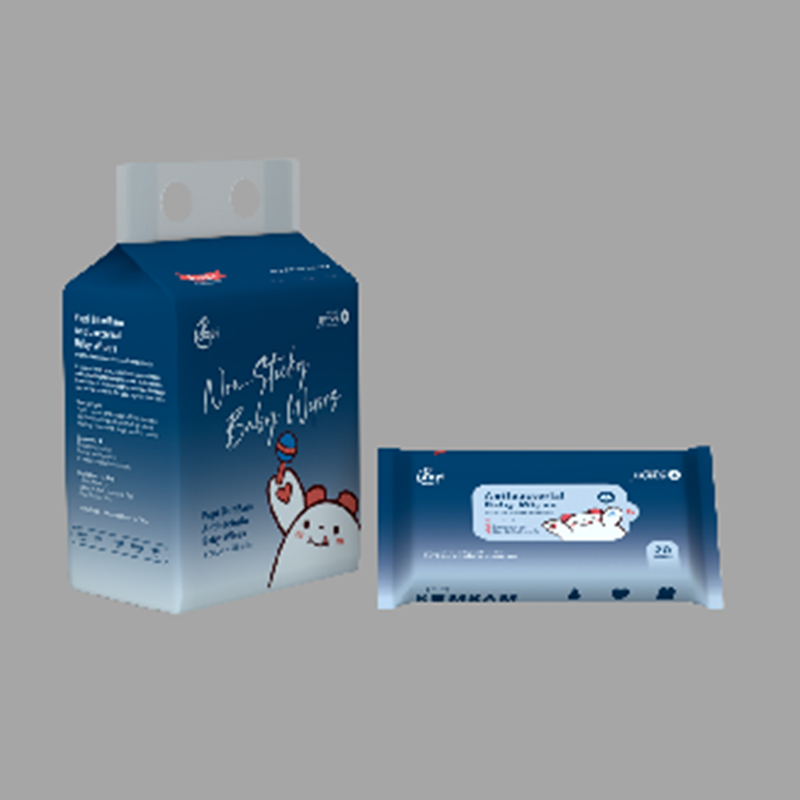 20-Pack Antibacterial Alcohol-Free Baby Wipes with Balanced pHThese wipes are formulated with a pH designed for sensitive skin, addressing the concern that alkaline liquids can damage a newborn's acid mantle. The 20-pack offers a convenient, gentle cleansing option.View Product →
When you evaluate a product, ask for the pH test result of the final wetted wipe, not just the liquid. The two can differ after the liquid is absorbed by the nonwoven. A laboratory that follows ISO 17025 standards or a GMP-compliant cosmetic manufacturer will provide the testing method and the measured range. The 20-pack antibacterial alcohol-free baby wipes from Wanfang Paper are formulated with a pH range designed for sensitive skin.
The liquid-to-fiber ratio is the industry shorthand for moisture content. Most baby wipes sit between 2.5:1 and 4:1. A 3:1 ratio gives a clearly damp wipe without leaving a pool of water on the skin. When a producer lowers the ratio below 2.2:1 to save cost, the wipe feels dry and does more friction damage than cleaning.
| Wipe category | Sheet size | Grammage | Wet tensile | Moisture ratio |
| Standard 3-ply | 150 x 200 mm | 50 gsm | 1.5 N/5 cm | 2.8:1 |
| Premium 2-ply | 150 x 200 mm | 65 gsm | 2.0 N/5 cm | 3.2:1 |
| Organic single-ply | 140 x 180 mm | 45 gsm | 1.6 N/5 cm | 2.6:1 |
| Pump-dispensed pure water | 150 x 200 mm | 55 gsm | 1.8 N/5 cm | 3.0:1 |
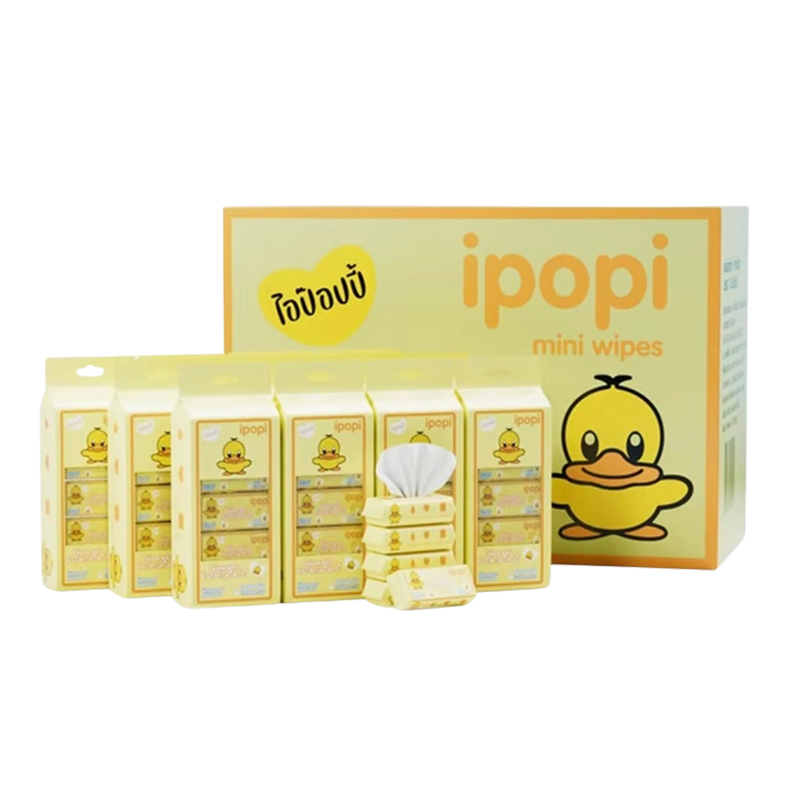
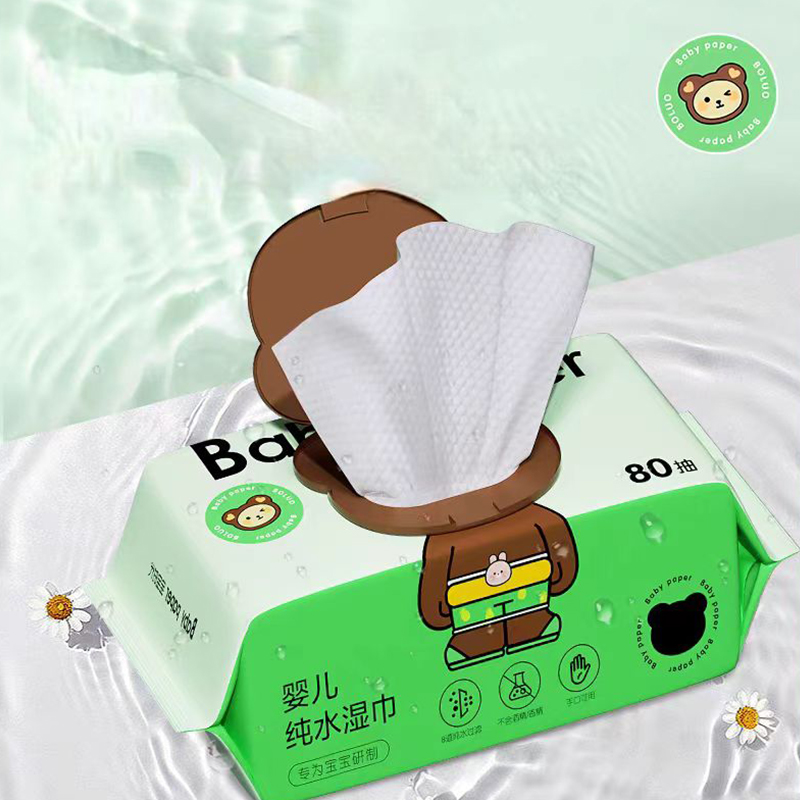 80-Pack Pure Water Wipes with Resealable Lid for Moisture RetentionThis large pack uses a rigid flip-top lid to keep internal humidity high after opening, ensuring the wipes stay moist and effective for daily use. Ideal for families needing a long-lasting supply.View Product →
Moisture loss is a packaging problem. In comparative tests on resealable dispensers, flip-top lids with a rigid hinge maintained internal humidity above 90% for 14 days after first opening, while peel-off sticker seals allowed up to 12% of total liquid to escape in the same period. For a bulk pack that a family uses over a month, this difference changes the actual number of usable wipes. Wanfang Paper's 80-pack baby pure water sanitary wipes use a rigid lid and a multi-sheet pull system that keeps the remaining sheets moist.
Thickness is measured in grams per square meter (gsm). Premium baby wipes typically range from 45 to 75 gsm. A 55 gsm wipe provides the best balance of softness and mechanical strength, but thickness alone does not prevent shredding.
Wet tensile strength is a more meaningful metric for baby wipes. In lab testing, results are often expressed in Newtons per 5 cm (N/5 cm). Values above 1.8 N/5 cm indicate a wipe that resists tearing when wiping a soiled area. Below 1.2 N/5 cm, the wipe separates under moderate force, leaving fibers on the skin.
Embossing and cross-directional fiber orientation improve sheet integrity. In our material testing, a 50 gsm sheet with an embossed pattern achieved a wet tensile strength comparable to a 60 gsm smooth sheet. Plant-fiber blends may offer slightly different performance, but the test method matters more than the raw material label.
Three design patterns dominate the baby wipes category: peel-off sticker, flip-top rigid lid, and pump dispenser. The peel-off sticker is cost-effective and common in small portable packs, but it loses adhesion after repeated use. The flip-top lid protects the remaining wipes from dust and moisture loss and is the default choice for medium and large packs. The pump dispenser adds a single-hand extraction mechanism: a pump action draws the wipe out without the user ever touching the interior, which keeps the remaining stack uncontaminated.
Lowest per-unit cost. Suitable for single-use and mini packs. Loses adhesion after repeated use, exposing the wipes to air.
Best for medium and large packs. Maintains internal humidity above 90% for two weeks. Adds a premium feel to the package.
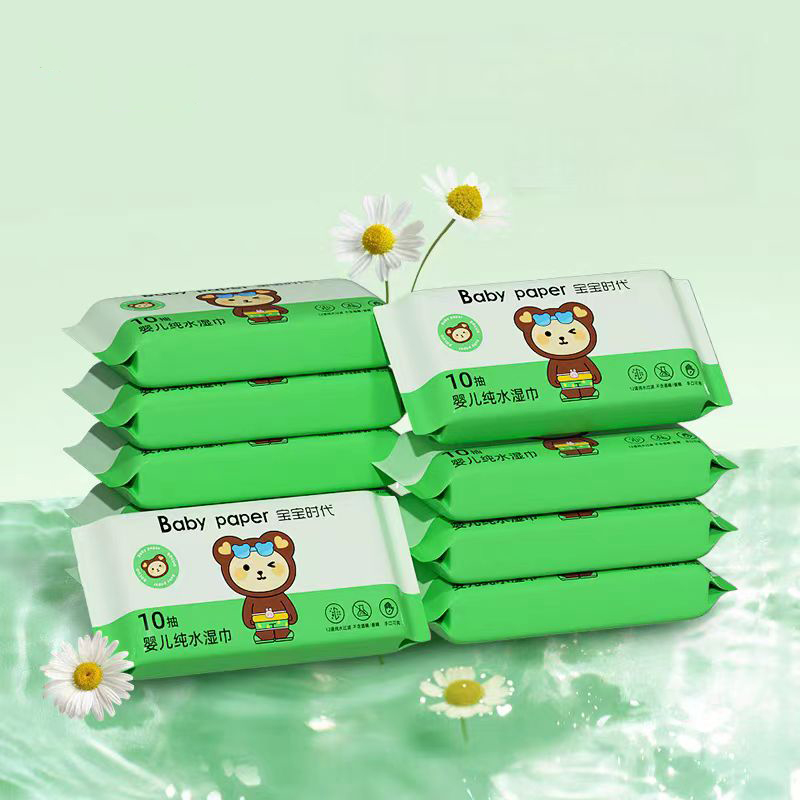 10-Pump Universal Pure Water Wipes for Baby's Hands and MouthDesigned with a pump dispenser for easy, controlled use and premium feel. Each pack provides purified water wipes that are alcohol-free and safe for cleaning baby's hands and mouth.View Product →
For a brand owner, the choice of dispensing hardware directly affects product cost, shelf appeal, and perceived quality. A pump dispenser adds roughly 10 to 12% to the per-unit packaging cost, but it supports a premium price point and a less wasteful usage pattern. The 10-pump universal pure water wipes from Wanfang Paper demonstrate this design with a hand-friendly pump that works for baby hands and mouths.
Certifications serve as an independent record of quality and safety. For baby wipes, ISO 22716 GMP is a stronger signal for manufacturing hygiene than ISO 9001 alone. A GMP certificate indicates that the facility follows documented procedures for personnel hygiene, production environment, and batch traceability.
Clinical evidence is the second layer. An HRIPT (Human Repeat Insult Patch Test) demonstrates a low potential for allergic reactions. Irritation tests such as the OECD 404 skin irritation test support non-irritant claims on the label. At Jingde County Wanfang Articles Commodity Co., Ltd, known in the market as Wanfang Paper, these principles guide the testing workflow for every baby wipes batch. For antimicrobial wipes, an efficacy test based on ASTM E1052 or EN 1500 should be documented. Review how antibacterial alcohol-free baby wipes perform against germs when such results are presented.
Here is the decision sequence we use when comparing a new baby wipes supplier:
Not necessarily. Alcohol is one ingredient to avoid, but preservatives like phenoxyethanol and fragrance allergens can also trigger reactions. The safest approach is to choose a wipe with a minimal ingredient list and dermatologist testing evidence.
A liquid-to-fiber ratio between 2.8:1 and 3.2:1 offers a balanced wet feel. Wipes below 2.2:1 feel dry, while those above 4:1 may leave excessive water on the skin and increase evaporation losses in the pack.
Sticky residue usually comes from humectants that are absorbed too slowly or from an imbalanced nonwoven surface. Choose a wipe with a lower humectant concentration and a well-bonded fiber structure to reduce adhesion.
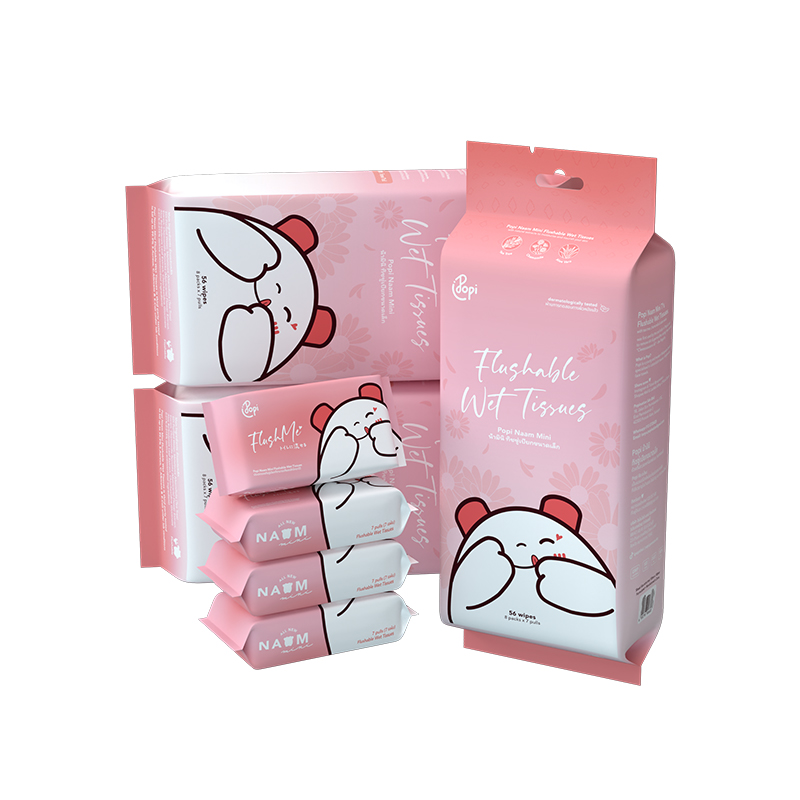
Flushability is convenient for disposable hygiene, but most plumbing systems cannot handle flushable wipes in large volumes. For baby care, a flushable-safe design is a bonus, not a requirement.





 English
 日本語
日本語 русский
 Español
 عربى
عربى